

03 – OPINION PIECE fvn, 18/11-26: A FUNERAL WAKE FOR INDEPENDENT SHOPS
English below
KRONIKK fvn.no
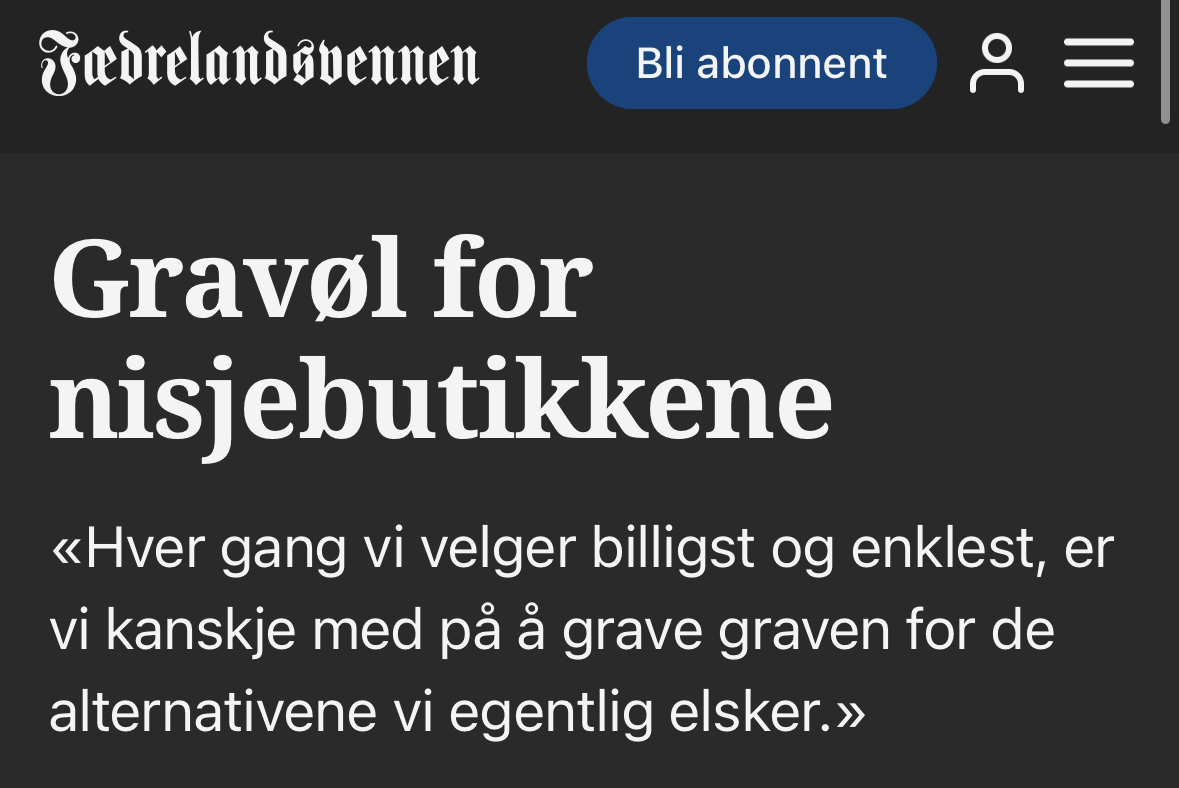
GRAVØL FOR NISJEBUTIKKENE
Jeg har skrevet en kronikk, publisert i Fædrelandsvennen 18/11-2026. Den er ikke bare skrevet på mine vegne, men for alle andre kunstnere, håndverkere og nisjebutikker.
Håper du vil lese!
Del gjerne 🙂
Gå til kronikk via denne linken:
https://www.fvn.no/mening/kronikk/o/dJd6mA/gravoel-for-nisjebutikkene
————
Today is a special day for me!
I’ve written my very first opinion piece, and I’m so happy to see it published in Fædrelandsvennen today!
This is something I feel deeply about, and I didn’t write it just for myself. I wrote it for all the artists, craftspeople, small independent shops, and passionate people who put so much of themselves into what they do.
I really hope you’ll take a moment to read it. And if the message resonates with you, I’d be so grateful if you shared it!
The text is in Norwegian, so here is a translation:
OPINION PIECE
A FUNERAL WAKE FOR INDEPENDENT SHOPS
“Every time we choose the cheapest and easiest option, we may be helping to dig the grave for the alternatives we actually love.”
I have worked as a product designer for 20 years, most recently for a home furnishings wholesaler. Design is exciting, but using my creativity to support mass production in China increasingly left a bitter taste in my mouth.
Today, I run my own business, Schøgren ART, on Flekkerøy, where I have my own studio and gallery, creating charcoal drawings and ceramic sculptures. What I make is time-consuming, intricate and unique. Something that stands out. Something that lasts.
A few years ago, I attended a large international interior design trade fair. At one of the stands, a machine was 3D-printing ceramic vases. Within minutes, beautiful, organic shapes emerged before our eyes. It was fascinating to watch the machine do exactly what it had been programmed to do.
Then someone asked me:
“Does this make you afraid for your craft?”
At first, I didn’t understand the question. Until I realised that we were looking at what stood before us through completely different eyes. I was quite clearly in the wrong place.
I couldn’t comprehend how thousands of identical, perfect vases could ever replace time-consuming, organic and unique craftsmanship.
Was the machine supposed to replace the knowledge? The experience? The traces of the hands that had created something? Everything that allows an object to carry a little piece of the person behind it. A soul, if you like.
And perhaps that very sense of human presence is more important now than ever before.
I think about the same thing when people ask whether I’m afraid that AI will take over art.
Because what would happen if we, as human beings, stopped recognising the value of our history, authenticity, human creativity, skills, craftsmanship and imperfection, simply because something else is faster, cheaper and more accessible?
And this is about so much more than art.
Every time we buy flowers at Kiwi, leather gloves at a pharmacy, cutlery at Biltema, scented candles at Obs or a fly-fishing rod at XXL, we undermine the independent specialty shops run by passionate people who genuinely love what they do.
Creative souls who have often spent years studying and learning far more than we ever see on the surface. People with expertise, passion and a genuine desire and ability to provide personal service.
Every time we shop online, we help pave the way for empty storefronts, deserted town centres and shop windows displaying closing-down signs.
Specialist shops lose revenue. Their product ranges shrink. Jobs for skilled professionals disappear. Fewer people enter the trades. Educational programmes are shut down. And with them disappears knowledge that has taken generations to build.
And this is happening everywhere, across countless industries.
This summer, Frivoll Hage, a local garden centre in Grimstad, shared a heartbreaking post on Facebook that deeply touched me and many others. The owner explained that business was struggling and feared they might not survive another season.
The response was overwhelming, and I believe it made us, as customers, realise that we need to support these businesses while they are still here. Otherwise, they will disappear.
But it’s so sad that things have to reach that point before we understand how serious the situation really is.
We often choose the cheapest and easiest option. But the combined effect of all those small choices has enormous consequences.
Do we really want large retail chains to replace expertise? Simply because they can buy in huge volumes and offer lower prices?
Surely we don’t?
Freedom of choice only exists as long as there are actual alternatives to choose from.
What good is being able to buy leather gloves for 199 kroner, made from the hides of undernourished animals in India and stitched by underpaid workers earning slave wages, if one day there is no one left who can help us find the right size, assess the quality or repair them?
What good is a cheap bouquet from Rema 1000 if there are no trained florists left when we need a bridal bouquet, a dignified funeral arrangement or something made especially for someone we love?
There is a clear connection between all of this, art, craftsmanship and AI.
Everything that can be made more efficient, mass-produced and cheaper probably will be.
And that is precisely why it is becoming even more important that we, as human beings, decide for ourselves what we believe has value.
I’m not afraid of a machine that can print a thousand perfect vases.
I’m afraid of those who cheer on a society where we can no longer recognise the difference between something mass-produced and something a human being has spent an entire lifetime learning to create.
A society where low prices and lack of time outweigh quality, personal service and human knowledge.
Christmas is approaching, and our bank cards are getting a workout.
Think about where you choose to spend your money.
Take a look at what is available locally. Local artists, craftspeople and independent specialty shops.
Buy something meaningful. Something that lasts. Something unique that no one else has.
Expertise and craftsmanship take a lifetime to build. But it may take very little time for us to lose them.
Leave a Reply